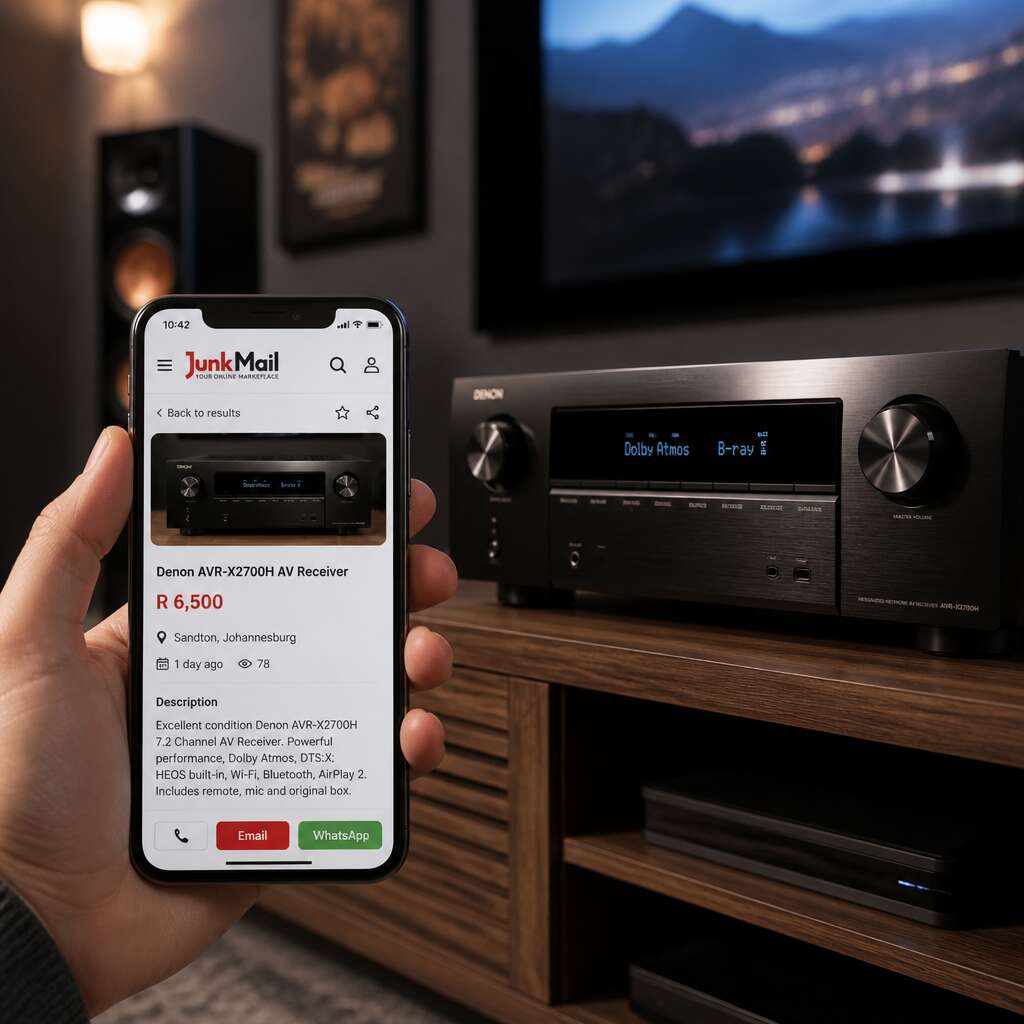
Understanding the Appeal of Discount Audio/Video Receivers
Why Consumers Seek Out Secondhand or Clearance Receivers
The sticker shock of a brand new AV receiver can feel like a personal insult, especially when you consider that your neighbours can hear your TV’s tinny speakers from their braai area. It is a common dilemma. You want that room-shaking, cinematic experience, but your budget is more aligned with a cup of coffee than a flagship amplifier. This is precisely where the savvy shopper starts to explore the world of secondhand electronics.
Many people are discovering that a slightly older model, when purchased through platforms like junkmail av receivers, offers performance that easily outclasses anything new in the same price bracket. The trade-off is simple. You sacrifice the latest Wi-Fi standard or a singular HDMI 2.1 port, but you gain a considerable amount of raw power and build quality. For the price of a budget unit, you can often secure a device that was once the pride of a home theatre enthusiast, packed with features that still work beautifully for modern setups.
The reasons for seeking out these clearance deals are as varied as the devices themselves, but a few consistent truths drive the hunt:
– The depreciation factor: AV gear loses value fast when new models drop, so you get tech that was high-end only a few years ago for a fraction of the cost.
– The upgrade cycle: Many owners sell perfectly good units just to chase the newest codec, leaving excellent hardware priced to move quickly.
– The price-to-performance ratio: You get more channels, more power, and better DACs for the same money, which is a significant win for the audio purist.
It is not just about being frugal, though that is a valid part of the appeal. It is about intelligence. It is about knowing that you can get 90 percent of the performance of a top-tier system without setting your bank account on fire. When you look at the classifieds, you are not just browsing for junk, you are hunting for value. A quick search for junkmail av receivers often reveals a treasure trove of options that savvy buyers snap up before they even hit the retail floor, saving hundreds of rands in the process.
The Difference Between Refurbished, Used, and Open-Box Units
An open-box receiver is simply a unit that went home with someone and came back within the return window. The discount is real, the hardware is untouched, and the box looks like it survived a rugby scrum. That cardboard damage is your discount.
Refurbished units have a history. They failed once, got repaired, and now carry a warranty that proves someone vouches for them. Used units listed under junkmail av receivers have no such paperwork. They exist on vibes and goodwill, which is exactly why the price is friendly.
Common Reasons Receivers End Up in Bargain Bins
Most A/V receivers are replaced before they fail. A 2024 survey found 60% of upgrades happen for new formats, not broken hardware. That dynamic, I think, explains the appeal of discount units. Functional internals, quality power supplies, and robust DACs persist across generations. The receiver merely lacks the latest port or codec.
Several forces push these units into bargain bins.
- Rapid HDMI standard changes
- Consumers trading up for gaming features
- Retailer overstock from model refreshes
Each force feeds the available stock of junkmail av receivers. In South Africa, where new gear carries heavy import costs, this surplus turns a luxury purchase into a practical one!
What to Expect From Older HDMI and Audio Formats
The newest HDMI specification changes the spec sheet more than it changes the sound. That reality underpins the appeal of older receivers. A 2018 unit with HDMI 2.0 still passes 4K HDR video and decodes lossless Dolby TrueHD tracks from physical media. Many listeners cannot perceive the differences between HDMI generations.
The audio formats people use are Dolby Digital Plus, Dolby TrueHD, and DTS-HD Master Audio. All three predate 2010. Streaming platforms still transmit Dolby Digital Plus at modest bitrates. Any functioning receiver from the last decade handles these without strain!
Shoppers browsing junkmail av receivers see port versions and codec acronyms that seem dated. The real question is whether their sources need the newer features. A Blu-ray player, satellite decoder, and television all output formats that older receivers decode natively. For South African homes, junkmail av receivers offer a practical way to quality sound without chasing newer formats.
Balancing Cost Savings Against Potential Drawbacks
A single HDMI cable can cost more than a secondhand amplifier. That price disparity explains the magnetic pull of bargain audio gear, particularly in a market where every rand counts. For the cost of a modest dinner out, a shopper finds a component that drives an entire speaker system. The appeal is not about getting a museum piece, but about unlocking a level of performance that new equipment simply cannot offer at that price point.
The trade-off is a nuanced matrix of compromise. These units may not support the latest 8K pass-through or VRR gaming features, but they often deliver robust amplification and clean power. Buyers typically accept the absence of a few modern conveniences in exchange for sonic substance. Common sacrifices in this realm include:
– No voice assistant integration
– Lack of eARC support on older models
– Heavier chassis, which makes shipping costlier
– Basic room correction software
That last point about room correction is where perception often diverges from reality. The digital equalization suites in modern units adjust for acoustic flaws, yet many older receivers handle this task with notable precision. The real consideration is whether the user has the patience to run a calibration microphone and make a few basic adjustments. For those who do, the result is a listening experience that rivals units costing ten times as much. The hunt for junkmail av receivers rewards those who understand that specs on paper rarely translate directly to sound quality in a room. It is a calculation of value, not a leap of faith.
Evaluating Condition and Performance Before You Buy
Checking for Physical Damage and Signs of Wear
The true character of a secondhand component is revealed in its scars. A scuffed corner might be a badge of honor from a decade of dedicated service, or it could be a warning of a hard life lived in a dusty, cramped cabinet. Before you hand over your hard-earned rand for junkmail av receivers, you must put the chassis under scrutiny, for the outside often whispers secrets about the components within.
Begin with the tactile assessment. Run your fingers along the edges and inspect the rear panel. A unit that feels sticky or greasy has likely endured excessive heat. The vents, those metal ribs that allow the amplifier to breathe, should be clear of thick dust bunnies. Blocked airflow is a common cause of premature failure in these high-wattage devices. Look closely at the binding posts and input jacks; they should be clean and free of corrosion. Rust is a terrible omen, suggesting the device has lived in a humid environment.
For a quick external checklist, consider these physical signs as you assess the treasure before you:
– Examine the feet and rubber pads for uneven wear, which indicates the unit was dropped.
– Check for a warped or cracked faceplate, which can distort the button alignment.
– Look at the ventilation grilles for any signs of melting or discoloration.
– Inspect the power cord for cuts, frays, or a chewed appearance.
Once the exterior passes muster, your ear becomes the primary tool for diagnosing the internal state. A gentle press on each button and a slow turn of every knob should produce a soft, quiet response, not a crackle or a scratchy protest. That static is the sound of a dirty potentiometer and an inevitable sign of aging. While the physical inspection tells you about the history of the unit, the first power-on will speak to its future. A hum that grows louder over time is a whisper of failing capacitors, a repair that is often more costly than the initial purchase of the junkmail av receivers themselves. The journey of evaluation is a dialogue between what you can see and what you can only hear.
Testing Ports, Connectivity, and Audio Outputs
The promise of a bargain can fade quickly when the ports that define a receiver’s utility arrive broken or dated. While the knobs and casing speak to physical history, the connectors on the rear panel dictate how the device interacts with your current entertainment system. You are not merely buying an amplifier; you are adopting a hub, and its ability to accept modern signals is paramount. A receiver with pristine audio components but dead input terminals is a silent monolith, impressive to look at yet useless for the task at hand.
Begin by testing each HDMI input methodically on the junkmail av receivers you are considering. Connect a known working source and listen for the satisfying click of the relay that locks the signal. Observe the picture for any sparkles or dropouts, which indicate a failing port or a loose solder joint. Do not assume all inputs are equal; a unit may have two faulty ports while three function flawlessly. The seller may not have been aware of these failures, which is a frequent occurrence in the secondhand market.
Audio outputs demand equal scrutiny. Connect speakers and cycle through each mode, from pure direct to stereo. Pay attention to how the receiver handles the digital to analog conversion over its coaxial and optical inputs. These older digital links are often the most fragile components.
– Test the phono input with a turntable, as many newer units omit this feature.
– Verify the subwoofer pre-out emits a consistent signal without hum.
– Confirm the speaker binding posts do not feel loose when inserting a banana plug.
Only by confirming each of these pathways can you trust that the receiver will serve its function. Connectivity is the silent language between your television, streaming box, and speakers. A fault here negates any sonic warmth the unit may possess.
Verifying Firmware and Software Compatibility
Thirty percent of secondhand electronics fail from firmware corruption before hardware faults appear. When reviewing junkmail av receivers, assess the software with the same care as the hardware. A unit can sound well yet stumble on HDMI handshakes with modern TVs, leaving a blank screen.
Navigate the setup menu first. Slow responses or garbled text signal corrupted firmware. Compare the installed version against the manufacturer’s database. Many brands support USB or network updates. Carry the latest firmware file on a flash drive when inspecting a unit. Confirm the receiver accepts it. A failed update can render the unit unusable.
- Power cycle the unit twice to verify boot consistency.
- Test every button on the remote, including setup and zone keys.
- Ask the seller whether firmware updates have ever been installed.
Junkmail av receivers arrive from homes where updates were ignored for years. That neglect creates compatibility gaps with current streaming sources. Verify the software pathways before paying to avoid the silent failures testing ports cannot reveal.
Understanding Power Ratings and Channel Configurations
Power ratings are the most lied-about numbers in secondhand audio. Sellers quote peak watts that mean nothing in real rooms. A receiver claiming 230 watts per channel might deliver 80 clean watts into two channels. Those are different measurements. When assessing junkmail av receivers, the configuration matters more than the sticker.
Most bargain units fall into three configurations:
– 5.1 channels for basic surround
– 7.1 channels for larger spaces
– 7.1.2 or more for object-based formats like Dolby Atmos
This matters because of how power is distributed. An amplifier can only draw so much from its power supply. A 7-channel receiver spread thin across all channels will strain during a busy movie soundtrack. Two-channel stereo performance often beats multichannel output by a significant margin.
The receiver’s impedance rating tells you about its true work capacity. Units rated for 4-ohm loads handle difficult speakers better. An 8-ohm-only receiver will overheat with thirsty floorstanders. Check the rear panel for both power figures and impedance specifications. The channel configuration should match your speaker layout. Purchasing a 9-channel receiver for a 5-speaker system wastes space and potential. A basic 5.1 unit with robust power per channel often sounds better than a budget 7.1 model stretched thin.
The rating published in the manual rarely reflects continuous output. Manufacturers measure at one channel driven at one frequency for a millisecond. Real listening demands all channels active across the full spectrum. That gap between marketing and reality is where junkmail av receivers either impress or disappoint. Listen with bass-heavy content at moderate volume. The power supply will reveal its limits through audible strain. Effective power is what remains after heat dissipation, not the number printed above the logo.
Identifying Red Flags That Signal a Poor Investment
The outer shell of a bargain receiver often hides the true story, but it is the place to start. A unit caked in dust and smelling faintly of cigarette smoke has lived a hard life. I have opened up junkmail av receivers that looked pristine on the outside, only to find a graveyard of corrosion and dead insects inside. The physical inspection should always extend beyond the front panel. You are buying a machine with moving parts and electrical pathways.
When you find a promising listing, the seller’s hesitation tells you more than the photographs. A genuine owner will happily discuss the speaker impedance they ran and the listening levels they used. A vague answer about how the unit was stored is a warning signal. The better the story sounds, the more closely you should look at the chassis. Scratches on the top plate indicate something heavy was stacked on it, which restricts airflow and accelerates component failure. The ventilation slots should be clear and free from grime.
There are certain markers that should make you walk away, regardless of the price.
- Burnt smell or a lingering chemical odor from the power supply region
- Bulging or leaking capacitors visible through the vent slots
- Replacement connectors or soldering work that looks amateurish
- A rear panel with missing screws or a bent power cord
The behaviour under load reveals the truth that specifications hide. A receiver that runs warm after an hour of moderate use is normal. A receiver that becomes hot to the touch within minutes has a compromised power supply or biased amplifier stages. Listen for the hum. A silent background with the volume at zero is a good sign. A persistent buzz from the transformer suggests age and fatigue that no amount of cleaning will fix. The protection circuits are there for a reason, but a unit that trips them repeatedly in a normal room is not worth the risk.
The electronic inspection demands your attention. Thermal paste dries out, and the contact between the heatsink and output transistors degrades over time. Look for signs of previous repairs. A clean factory solder joint is shiny and uniform. A reworked joint looks dull and blobby. The HDMI board is a common failure point on older units, and a bargain price does not make a dead board more convenient. The condition of the relay chips and the HDMI switch determines whether the unit will work with the modern gear you own. Every layer of inspection filters out a potential headache, leaving you with a receiver that might actually serve you for years.
Researching Model History and Known Defects
The receiver’s biography matters as much as its fascia. Before you commit to any of the junkmail av receivers that catch your eye, search the model number alongside words like “failure” and “repair.” Owners document quirks in forums, and those threads reveal patterns no spec sheet shows. A particular series might suffer HDMI board deaths at the three year mark. Another might run hot by design, shortening capacitor life.
When I evaluate a unit, I build a checklist.
- Cross-reference the model against known defect databases.
- Check the manufacture date, printed on the rear sticker, against recall notices.
- Read user reports about specific firmware versions.
That research shapes how I test the actual unit. A receiver with a documented amplifier fault deserves extra scrutiny at moderate volumes. A model notorious for network board failures gets a longer Wi-Fi and Ethernet test. For junkmail av receivers, community knowledge is the difference between a bargain and a repair bill. It turns a gamble into an informed calculation.
Where to Uncover Hidden Gems in AV Equipment
Navigating Online Marketplaces and Auction Sites
Auction listings for receivers rarely attract more than a dozen bids, even when the starting price dips far below market value. This niche rewards patience. Local marketplace photos often use poor lighting, hiding scratches but also obscuring genuine condition. A careful eye makes the difference.
Seller timing shifts outcomes. Listings posted late Sunday see fewer eyes. I have seen that sorting by newly listed exposes gear that most buyers miss. Bulk lots hide the best deals, where one receiver arrives alongside other useful components. Exact model numbers in searches pull up forgotten listings.
- Location filters reduce delivery complications
- Listings without remotes attract fewer watchers
- Seller history hints at original purchase dates
For junkmail av receivers, the process involves regular checks and quick decisions. Unexpected finds appear at odd hours! A receiver that sits unclaimed can become a solid purchase once all prior checks confirm its condition.
Local Thrift Stores, Pawn Shops, and Garage Sales
There is a particular silence in the back corners of a thrift store, a dust that settles on forgotten electronics. It is here, amidst the coffee machines and orphaned cables, that the true hunt begins. The owners of pawn shops often lack the patience for the technical, pricing the heavy black components as mere scrap metal. You hear their stories, the people who have abandoned their home theater dreams without a second thought.
Garage sales are transitory things, offering strange opportunities for those who arrive early with cash. The owners cannot test the equipment; they just want the space back. This pursuit is a different rhythm, one of sunlight on cracked driveways and the weight of a heavy chassis in your arms.
– Always bring a known source of power.
– Ask for the original packaging, which often holds manuals.
– Check the speaker terminals for rust, which signals long storage.
For those frustrated by online competition, these physical locations often hide what the digital world misses. The term junkmail av receivers describes the entire category, but the best finds rarely reach that platform. They wait in glass cases and on dusty shelves, ready for a silent negotiation. The true value is in knowing what you are looking at before anyone else does.
Manufacturer Clearance Sections and Outlet Stores
Outlet stores offer a different silence, one that hums with fluorescent light and unopened cartons. Manufacturers clear their backlogs here, units that failed a final inspection or returned from a retail trial. The discount is real, but so is the reason! Between the scratched fascia and the missing remote lies a story.
I find the clearance section requires its own patience. Unlike the thrift shop, the stock is deliberate, chosen by people who know exactly what they are selling. That knowledge cuts both ways. They will not let a receiver go for scrap; they also cannot hide a poor HDMI implementation.
- Look for units with cosmetic damage only, the cheapest flaw.
- Ask about the return policy on clearance items.
The junkmail av receivers crowd often overlooks these outlets, assuming the best deals stay online. A manufacturer’s own clearance section offers something those junkmail av receivers listings rarely do: a seller who knows the product’s history and still chooses to let it go. That honesty has a price.
Online Forums and Community Buy/Sell Boards
Online forums and community buy/sell boards hold a different class of gear. The sellers are often hobbyists who have posted for years, not liquidators. They price receivers to move because the unit occupies shelf space. They also know exactly what they are selling, which cuts both ways.
Few junkmail av receivers searches reach these boards. The listings sit among speaker cable threads and amplifier debates. The payoff is real. A seller with a long history cannot hide a faulty HDMI port. The community remembers.
- Long-time members price gear to move, not to profit
- Detailed post histories outweigh any description
- Previous buyers answer direct messages with context
That last point carries the most weight. Their replies reveal how the seller handles complaints, refunds, and unhappiness. That information is hard to fake.
Liquidation Auctions and Wholesale Lots
Liquidation auctions and wholesale lots occupy a strange middle ground. They appeal to the gambler’s instinct, the part of us that believes untold riches sit concealed behind a sealed cardboard lip. One pallet might contain a tower of battered DVD players and a kettle. The next could hold three comparable units, their warranties long expired. The prices tempt, but the condition remains a mystery until the auctioneer’s gavel falls.
Finding worthwhile junkmail av receivers in these spaces requires a shift in mindset. A retail buyer scans a shelf. An auction participant reads a manifest. They study the lot numbers, the photos, the seller’s note about “dead stock.” The absence of individual testing means the bargain hunter accepts risk as the entry fee. Some purchasers build their entire strategy around this uncertainty, flipping damaged goods for parts.
The true advantage here is volume. A single lot provides multiple units to test, and that changes the calculation entirely.
– One receiver might power up and pass every port test
– Another may need a simple HDMI board replacement
– A third could be sold as parts, absorbing the overall cost
Buying in bulk lowers the effective price per unit. The successful participant does not seek a single perfect machine. They seek an average that works in their favor.
Local auction houses often hold these estate and business clearances. The wholesale pallets arrive from logistics companies, retailers, and rental firms. South African buyers should verify the viewing day, inspect what they can, and understand the buyer’s premium before bidding. International lots complicate matters with shipping costs and currency exchange. The local auction removes those hurdles, but it also removes the romance of the unknown. You see the boxes. You just cannot see inside them.
The real art is knowing which palettes to skip. Piles of esoteric amplifiers gather dust. Heaps of late-model receivers with standard connections attract the professionals. The private buyer who shows up early, reads the manifest, and stays disciplined during the bidding often walks away with a stack of units. Not all of them work. A few, however, might be quite exceptional.
Smart Negotiation and Safe Purchase Practices
How to Spot Overpriced Listings and Fair Market Value
Seeing a R12,000 receiver listed for R4,000 sparks suspicion. Fair market value on junkmail av receivers seldom drops below half the original price unless the unit has flaws. Compare asking prices against recently sold items on auction sites for similar models with comparable wear.
When you spot an overpriced listing, anchor your offer with documented evidence. If a seller quotes R3,500 but the last three sales landed at R2,800, state that range. Most sellers base price on emotion, not depreciation.
- Compare power output and HDMI version against current specs
- Subtract repair costs for missing remote or scratched casing
- Ask for original purchase receipt to verify age
Safe buying for junkmail av receivers extends beyond price. Meet in a public place with AC power and test the receiver before paying. For long distance deals, use a payment method with buyer protection. If a seller refuses to demo the unit, walk away.
Politely Negotiating With Sellers for Better Prices
A polite negotiation is not a duel. It is an exchange of information. When you approach a seller about junkmail av receivers, your first message should acknowledge their listing. Express interest in the model. Then, present your reasoning for a lower offer. Mention specific wear you observed in the photos or a missing accessory. Sellers respond better to logic than to lowball numbers.
One in five sellers will accept an initial offer below asking if the buyer shows serious intent. Serious intent means you have cash ready and a schedule for pickup. Before you send that offer, verify a few details. Ask about the unit’s history and its original packaging. This conversation builds a case for your price point.
– Confirm the receiver has not been repaired with nonstandard parts.
– Ask about the environment where it was used, such as a smoky room or a garage.
– Request a short video of the receiver powering on with sound.
Frame your final offer around these findings. A clean unit warrants a higher price, but a dusty, scratched model with a missing remote deserves a discount. Most sellers on these platforms expect negotiation. Offer a price that reflects the true condition, then meet somewhere in the middle. For safe buying, always test the receiver before handing over cash. Suggest a public venue with an AC outlet. If the seller hesitates to demo the unit, your walkaway price becomes the only price you need to remember.
Requesting Detailed Photos and Demonstration Videos
A photograph can conceal more than it reveals. When you are serious about junkmail av receivers, request photos taken under direct light. Show
Using Secure Payment Methods and Avoiding Scams
Once you and the seller settle on a price for junkmail av receivers, the next test is the payment itself. A deal can sour quickly when someone pressures you to use an untraceable method. I have walked away from more than one promising transaction because the seller insisted on a direct bank transfer to a personal account before I could even inspect the unit. That instinct has never failed me!
For high value items like junkmail av receivers, treat payment security as part of the purchase. Meet in a public location with CCTV coverage if you are buying in person. Use payment methods that offer buyer protection, such as credit card payments or recognised escrow services offered by reputable online marketplaces.
- Confirm the seller’s identity and phone number before committing.
- Never pay by cryptocurrency, gift card, or cash deposit into an unknown account.
- Request a dated receipt or proof of payment from the seller.
Be wary if the seller suggests an obscure payment app or asks for a deposit to hold the item. Those requests often precede a scam, especially when paired with pressure to act quickly.
Return Policies, Warranties, and Buyer Protection
When you buy junkmail av receivers, the return policy is your last line of defence against a seller who vanishes like morning mist. In South Africa, many private sellers offer no warranty at all, so you must ask for one in writing before handing over a cent. A seller who hesitates to put terms on paper is a seller who plans to disappear.
Buyer protection on classifieds is often thin. Check whether the platform offers any dispute resolution, and confirm the seller’s physical address. Your rights under the Consumer Protection Act apply to registered dealers, not private individuals, which makes documentation vital when purchasing junkmail av receivers.
- Request a signed return agreement for faulty units.
- Ask for the original receipt or proof of purchase.
- Confirm the warranty period and who handles repairs.
Without these details, a bargain becomes a burial.
Arranging Safe Pickup or Shipping for Fragile Gear
Negotiating for junkmail av receivers is rarely about the sticker price alone. When a seller on a classifieds platform drops their asking figure by a few hundred rand, the real cost often hides in the details surrounding delivery and verification. I have seen buyers celebrate a seemingly sharp deal, only to discover the unit arrives with a bent HDMI port or a cracked display panel, the damage artfully hidden in a photo taken at the perfect angle. The negotiation should therefore pivot to logistics and proof, not just the number on the screen.
For a local pickup, the process becomes a test of the seller’s patience. Ask probing questions about the unit’s history while you arrange a time. A genuine seller will offer a live demonstration on the spot, perhaps even with the receiver connected to speakers. If they hesitate to meet in a public, well-lit space like a mall parking lot or a police station precinct, treat that reluctance as a warning. For heavier units, bring a friend; lifting a 15 kilogram amplifier awkwardly can cause more damage than any bump in the road.
Shipping introduces another layer of complexity. Junkmail av receivers weigh enough that careless couriers can wreak havoc on internal circuit boards. When a seller insists on posting the unit, demand specific packaging details before you commit to payment. A double-walled box, thick foam corners, and a layer of bubble wrap around the chassis are non-negotiable. I once received a receiver that was packed in a thin plastic bag and a cereal box. The transformer had torn loose from its mounts, rattling inside the case like a loose marble. Insist on insurance, and request photographic evidence of the package before it leaves the seller’s hands.
If the seller cannot provide that proof, or if they suggest a courier that only offers minimal liability, you should walk away. The fragility of these machines is not a secret. The negotiation does not end when you agree on a price; it continues through every step of the handover. Securing a signed agreement about the condition, a clear photograph of the serial number, and a detailed verbal confirmation of any known flaws will save you from a headache later. When the risks stack up, the only smart move is to let the seller keep their precious junkmail av receivers and wait for the next listing.
Extending the Life and Performance of a Budget Receiver
Cleaning and Maintaining Internal Components Safely
Dust buildup inside a secondhand receiver shortens component life. After scoring a deal on junkmail av receivers, you might feel tempted to open the chassis and blow out years of accumulated fluff. Resist the urge to use a household vacuum cleaner. The static charge can fry sensitive circuits, and you might knock a capacitor loose. Instead, use a can of compressed air, but keep the nozzle at least ten centimeters away. Canned air is the safest first step.
Once you have the cover off, inspect the PCB for bulging capacitors or charred resistors. These signs mean the receiver has lived a hard life. For cleaning, follow a simple sequence:
- Unplug the unit and wait 15 minutes for capacitors to discharge.
- Use short bursts of compressed air to dislodge dust.
- Brush stubborn residue with a soft paintbrush.
Only touch internal boards with dry hands or an anti-static strap. Moisture is your enemy. A slightly warm, dry cloth on the exterior is fine, but never spray cleaner directly into vents. When you finally reassemble, the renewed airflow keeps components cool, extending the life of your bargain find.
Updating Firmware and Using External Streamers
The physical resilience of a secondhand chassis means little if its digital brain is frozen in time. Updating firmware on older units can restore compatibility with modern codecs, though the process often requires a USB flash drive and patience. Many budget receivers from the last decade lack network ports entirely, so sideloading updates becomes a manual ritual. Owners should check the manufacturer’s support page before assuming a model is obsolete; a single patch sometimes unlocks features that were dormant at launch.
External streamers offer a superior alternative to wrestling with dated smart interfaces. A dedicated media player bypasses sluggish menus and adds support for newer audio formats, while the receiver simply handles amplification. This separation often yields cleaner sound, as the amplifier avoids processing unnecessary digital noise. Here is how to integrate an external device effectively:
- Connect the streamer to an unused HDMI input on the receiver.
- Set the receiver to a direct or pure audio mode for a untouched signal path.
- Disable the receiver’s internal video processing if the streamer outputs its own signal.
Ultimately, many junkmail av receivers become reliable workhorses when paired with a modern source component. The amplifier remains the heart of the system, but a $40 streamer often outperforms the built-in circuitry of a decade-old receiver. South African homes with fluctuating power should also consider a stable voltage regulator, as firmware updates and streaming devices are sensitive to surges. This combination of old hardware and new peripherals yields performance that surprises those who dismiss budget finds.
Pairing With Efficient Speakers for Optimal Sound
The real voice of any amplifier is the speaker attached to it. A bargain receiver from junkmail av receivers might boast impressive wattage, but that power means little if the speakers demand more than the amp can give. Efficient speakers, those with high sensitivity ratings, turn modest power into generous volume. They allow the amplifier to operate within its comfort zone, reducing strain on capacitors and output transistors.
Pairing a budget receiver with well matched speakers also improves clarity. The amp no longer pushes into distortion, and the soundstage opens up. In South African living rooms, where space is often limited, bookshelf speakers with 90 decibels or more sensitivity work wonders. They breathe life into old hardware without requiring expensive upgrades.
- Look for nominal impedance between 6 and 8 ohms.
- Check sensitivity above 90 decibels.
- Match the receiver’s power rating per channel.
This synergy between receiver and speaker often outperforms far costlier combinations. The amplifier stays cool, the music stays clear, and the system lasts longer.
Adding External Amplifiers or Switchers for Flexibility
A budget receiver from junkmail av receivers often has a capable preamp section but a modest power stage. Adding an external amplifier for the main channels shifts the heavy lifting. The internal amp runs cooler, capacitors face less stress, and the receiver’s lifespan extends. Many older units have preamp outputs, so this upgrade path remains accessible.
A switcher solves input scarcity. Rather than unplugging cables for each new device, a switch box consolidates several sources into one input. This reduces wear on the receiver’s rear panel jacks and keeps signal paths short.
- Select an amplifier with similar gain to avoid drastic volume changes.
- Choose a switcher that supports the audio bandwidth you need.
- Place both components with adequate airflow.
With a modular setup, the receiver becomes the control centre. Even a decades old unit from junkmail av receivers can adapt to changing audio gear. That flexibility turns a bargain into a long term foundation.
Troubleshooting Common Older Receiver Issues
Most secondhand receivers die from neglect, not age. Dust and heat are quiet assassins. A junkmail av receivers unit may arrive with grime inside. That film traps warmth and accelerates capacitor fatigue. A faint buzz from the speakers signals a struggling power supply.
Troubleshooting starts with the protection circuit. If the receiver clicks into standby after a few seconds, a shorted wire or failing output transistor is the culprit. A worn relay produces a delayed click. These parts are cheap.
- Listen for distortion at low volume, which points to dirty pots or corroded jacks.
- Test each channel with a known speaker to isolate dead outputs.
Many vintage receivers only need a reset. Unplug the unit for a minute to clear the glitch that freezes the display. In South Africa, power surges are common. A surge protector is not optional. It is the cheapest insurance for a bargain receiver.
Knowing When to Move On From an Aging Unit
Some receivers reward a little attention. A unit from junkmail av receivers can deliver years of service if you treat it kindly. Start with ventilation. Leave a hand’s width of space above the chassis. A quiet fan, placed nearby, moves warm air without adding noise. Clean the exterior vents monthly with a soft brush.
Your listening habits matter too. Avoid pushing the volume into distortion. That strain heats the output transistors. A budget unit sounds best when it runs at moderate levels. Match the impedance of your speakers to the receiver’s rating. A mismatch forces the amplifier to work harder. It dulls the sound and shortens the part’s life.
A few simple habits to preserve performance:
– Keep the unit powered down during electrical storms.
– Unplug it if you leave home for more than a week.
– Dust the top grille with a microfiber cloth.
There comes a moment when repairs outstrip the value. A receiver from junkmail av receivers might ask for new capacitors every few years. That is normal. But when the tuner drifts, the display fades, and the volume pot scratches despite cleaning, the end is near. A replacement board costs more than a working secondhand unit. Shipping a heavy chassis for repairs is expensive. You might spend R1,500 on labour for a receiver worth R800. Let it go. Sell it for parts or recycle it responsibly. The money goes toward a unit with better HDMI handling. That is a fair trade.

0 Comments